
Who we are
WrEN is a collaborative project between University of Stirling, Forest Research and Natural England, working in partnership with a range of government advisory agencies and non-governmental organisations. A large number of people have contributed to ideas, organisation, data collection and analysis.
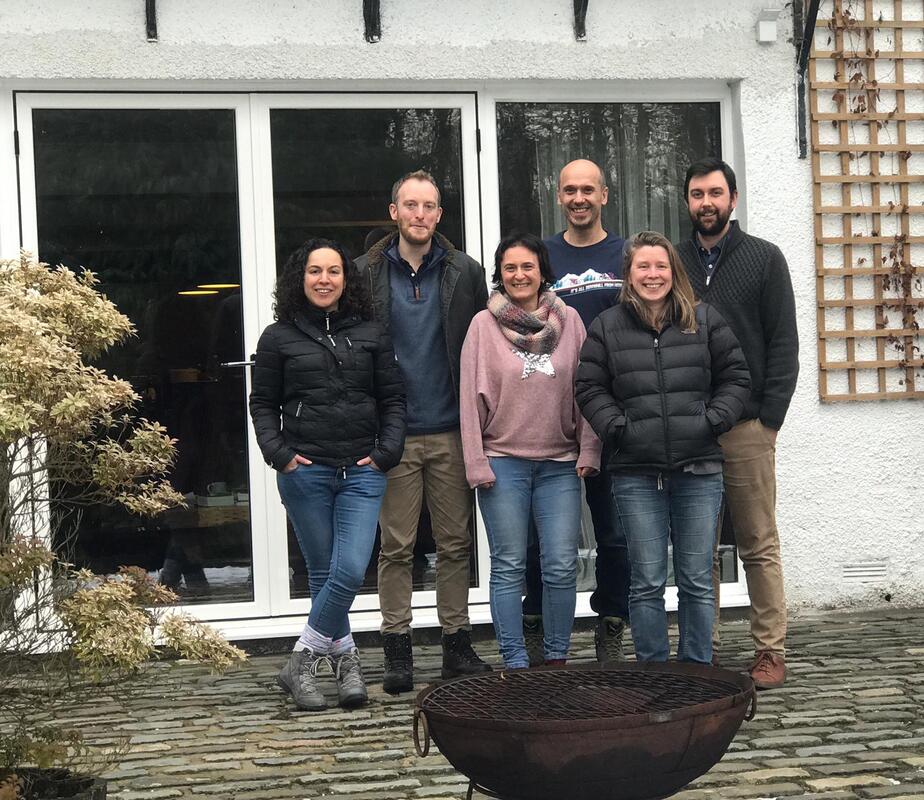
The WreN team on "retreat" in January 2019. From L to R: Elisa Fuentes-Montemayor, Frank Ashwood, Elena Vanguelova, Kevin Watts, Kirsty Park, Robbie Whytock,
Currently the core team consists of:
Professor Kirsty Park (University of Stirling)
Dr Elisa Fuentes-Montemayor (Research Fellow, UoS)
Dr Robbie Whytock (Postdoctoral researcher, UoS)
Dr Kevin Watts (Forest Research)
Currently the core team consists of:
Professor Kirsty Park (University of Stirling)
Dr Elisa Fuentes-Montemayor (Research Fellow, UoS)
Dr Robbie Whytock (Postdoctoral researcher, UoS)
Dr Kevin Watts (Forest Research)
Collaborators past and present
- Dr Frank Ashworth (Forest Research)
- Olivia Azevedo (PhD student, UoS)
- Dr Simon Duffield (Natural England)
- Dr Matt Guy (Forest Research)
- Mark Ferryman (formerly Forest Research)
- Dr Lauren Fuller (now at SEPA)
- Sam Hughes (PhD student at University of Leeds)
- Prof. Bill Kunin (University of Leeds)
- Dr Nick Macgregor (now at Parks Australia)
- Dr Elena Vanguelova (Forest Research)
- Dr Sietse van der Linde (Forest Research)
- Dr Clare Wilson (University of Stirling)
- Dr Robin Gill (Forest Research)
Students
Many undergraduate and master's students, based at Stirling or elsewhere, have contributed to the WrEN project and are listed in chronological order below:
- Ed Lewis (undergraduate, University of Edinburgh) "Ground flora species in secondary woodlands", 2013
- Thomas Armitage (undergraduate, UoS) "Ground invertebrate communities in secondary woodlands", 2014
- Jamie Irvine (undergraduate, UoS) "Ground invertebrate communities in secondary woodlands", 2014
- Lauren Murphy (masters, UoS) "Bryophyte distribution in secondary woodlands", 2014
- Clare Porteous (masters, UoS) "Ground flora species in secondary woodlands", 2015
- Emma Ghesquière (masters, Rennes University, France) "Bird occupancy patterns in secondary woodlands", 2016
- Suzie May-Graham (masters, University of Leeds) "Use of secondary and ancient woodlands by foraging bats in England", 2016
- Marike Whyte (masters, University of Leeds) "Ground invertebrate communities in secondary and ancient woodlands in England", 2016
- Anna Bolger (undergraduate, UoS) "Flying insect communities in secondary and ancient woodlands", 2017
- Adreea Boston (masters, University of Aberdeen) "The influence of hedgerows on bat foraging activity in woodlands", 2017.
- Ron Rotbarth (undergraduate, UoS) "Use of secondary and ancient woodlands by foraging bats in Scotland", 2017
- Nadine Royle (undergraduate, UoS) "Ground invertebrate communities in secondary and ancient woodlands in Scotland", 2017
- James Winter (masters, UoS) "Assessing the impact of hedgerows on the activity of bats in central Scotland", 2017.
- Kypfer Cordts (masters, UoS), "Elucidating the effects of woodland succession on bats using LiDAR", 2018.
- Michael Masters (masters, UoS) "The influence of local and landscape scale variables on the dawn chorus timing within a woodland network", 2018.
- Frazer Silcock (undergraduate, UoS) "Comparison of avian communities in secondary and ancient woodlands", 2019.
- Veronica Furey (undergraduate, UoS) "Examining responses of mammals to woodland creation using camera trapping", 2020.
- Imogen Schwandner (undergraduate, UoS) "Examining responses of mammals to woodland creation using camera trapping", 2020.
- Ben Catchpole (undergraduate, UoS) "Influences of local and landscape-scale attributes on mammal habitat selection in isolated woodlands planted within the last 160 years", 2021.
- Luigi Cristofaro (undergraduate, UoS) "Using camera traps to evaluate the effects of woodland creation on the presence of three groups of mammal", 2021.
- Bethany Wardhaugh (undergraduate, UoS) "Examining responses of mammals to woodland creation using camera trapping", 2021.
- Aimee Jackson (undergraduate, UoS) "Using camera traps to assess the influence of local and landscape-level attributes on the presence of woodland mammals in Central Scotland", 2021.
- Kimberley Smith (masters, UoS) "Examining responses of mammals to woodland creation using camera trapping", 2021.
- Ash Ronaldson (undergraduate, UoS) "Exploring large mammal responses to woodland creation using camera trapping", 2022.
- Robyn Clamp (masters, UoS) "Examining responses of mammals to woodland creation using camera trapping", 2022.
- Rachel Cockbain (undergraduate, UoS) "Do local and landscape level attributes influence deer species in secondary woodlands?", 2022.
Field assistants & contractors
Our work would not have been possible without the work of the skilled field assistants who have contributed to the WrEN field surveys and taxonomic identification. Listed in chronological order below:
- Katja Bitenc, invertebrate surveys, 2014
- Stephen Brennan, small mammal surveys, 2014
- Ruth Coxon, small mammal surveys, 2014
- Natasha Hambley, small mammal surveys, 2014
- Ian Hayward, invertebrate surveys, 2014
- Holly Langridge, small mammal surveys, 2014
- Roy Allen, invertebrate surveys, 2015
- Joe Hope, lichen surveys, 2014-15
- Zeltia Lopez, bat sound analysis, 2014-15
- Rory Whytock, bird surveys, 2015
- Scott Wilson, ground flora surveys, 2015
- Paul French, bird surveys, 2015
- Pete Carey, ground flora surveys, 2015-16
- Lloyd Garvey, beetle identification 2015-17
- Katy Baird, spider identification 2015-19
- Philip Sansum, moth surveys, 2017
- Will Scott, moth surveys 2017
- Matt Guy, mammal surveys, 2020
- Josh Weaver, herbivory & mammal surveys, 2022
- Erica Tonhauser, herbivory surveys, 2022
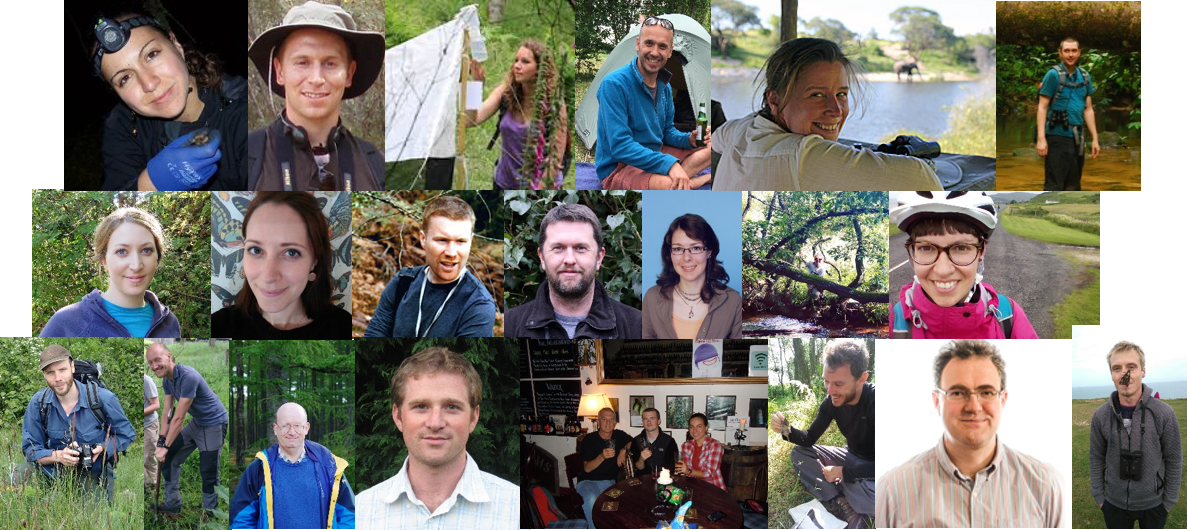
Some of the WrEN team....